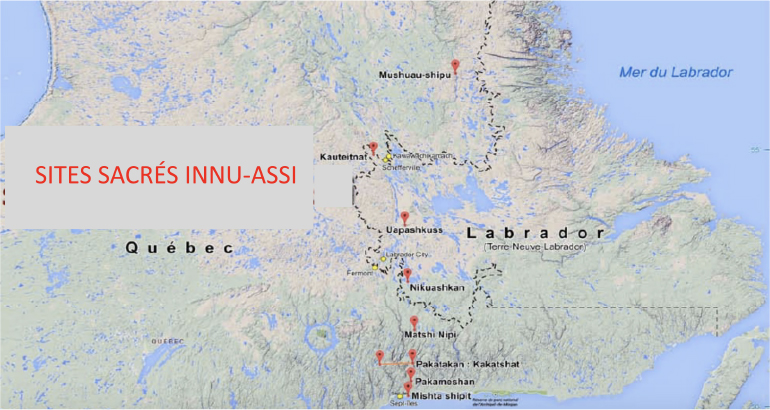
To date, Mishta Meshkenu has identified eight sacred sites located on Innu land, including Mishta-shipit, Pakameshan, Kakatshat, Matshi-nipi, Nikuashkan, Uapashkush, Kauteitinat, Mushuau-shipit.
This series of sacred natural sites represents part of the Innu Trail across rivers, portages, mountains and lakes to travel our land of life, our home. The ultimate goal of this long journey is to meet the caribou for the survival of our nomadic people throughout the four seasons.
The UAPASHKUSS group defines itself as Guardians of Innu sacred sites.


This status is the only status at the federal level that provides permanent protection for a place (not an area) because of its cultural or historical heritage. According to the law, such a place is defined as follows: A site, building, or other place of national historic interest or significance, including buildings or structures that are of national interest because of their age or architecture. An example is T'äw Tà'är which has been recognized as a historic place as a central point in the genealogical continuity of the Athapaskan people of the Yukon.
Nomination: Depending on the site, the application must be made to the Department of Environment and Climate Change and the Historic Sites and Monuments Board of Canada.
Duration: Permanent
Useful links:

This status attempts to protect natural heritage and was created under the Natural Heritage Conservation Act and is granted by the Quebec government on lands considered public on varying grounds. For example, in 2020, the government used this status to protect the Mushuau-nipi site and the caribou population of the region by justifying the cultural importance to the Innu people (see the following link).
Nomination: The request must be made directly to the Ministry of the Environment and the Fight against Climate Change according to the governmental guidelines in effect at the time of the request. Memoranda from this same ministry approve the new reserves.
Duration: Permanent or until protected area status is obtained.
There are also legal statuses that are not related to territorial protection, but which may have the same effect.
An example under the Quebec legal framework is a mining title commonly referred to as a claim. A claim is a mineral exploration title under the Quebec Mining Act which gives "the exclusive right to prospect for minerals" (s.53.1b). If a claim is affixed to an area for prospecting, however, the holder has no obligation to prospect. The Upashkuss custodian group obtained a guarantee from a claim holder that it would not use the claim.
In this sense, because the right to a claim is exclusive, the claim area is protected. There are, of course, limitations to this kind of protection, including that it is temporary and relies on the word of the claim holder.
By this category, we want to show that there are several legal statutes that can potentially be mobilized for the purpose of land protection.